Farsi    Arabic    English   
  

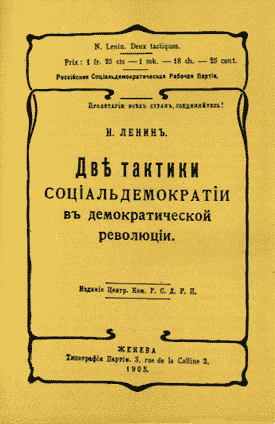
Two Tactics of Social-Democracy
in the Democratic Revolution[*]

V. I. Lenin


Preface

In a revolutionary period it is very difficult to keep abreast of events, which provide an astonishing amount of new material for an evaluation of the tactical slogans of revolutionary parties. The present pamphlet was written before the Odessa events[1]. We have already pointed out in the Proletary (No. 9—"Revolution Teaches")[2] that these events have forced even those Social-Democrats who created the "uprising-as-a-process" theory and who rejected propaganda for a provisional revolutionary government actually to pass over, or begin to pass over, to the side of their opponents. Revolution undoubtedly teaches with a rapidity and thoroughness which appear incredible in peaceful periods of political development. And, what is particularly important, it teaches not only the leaders, but the masses as well.

There is not the slightest doubt that the revolution will teach social-democratism to the masses of the workers in Russia. The revolution will confirm the program and tactics of Social-Democracy in actual practice, by demonstrating the true nature of the various classes of society, by demonstrating the bourgeois character of our democracy and the real aspirations of the peasantry, who, while being revolutionary in the bourgeois-democratic sense, harbour not the idea of "socialisation," but of a new class struggle between the peasant bourgeoisie and the rural proletariat. The old illusions of the old Narodism, which are so clearly visible, for instance, in the draft programme of the "Socialist-Revolutionary Party" on the question of the development of capitalism in Russia, the question of the democratic character of our "society" and the question of the significance of a complete victory of a peasant uprising—all these illusions will be mercilessly and completely blown to the winds by the revolution. For the first time it will give the various classes their real political baptism. These classes will emerge from the revolution with a definite political physiognomy, for they will have revealed themselves, not only in the programs and tactical slogans of their ideologists, but also in the open political action of the masses.

Undoubtedly, the revolution will teach us, and will teach the masses of the people. But the question that now confronts a militant political party is: shall we be able to teach the revolution anything? shall we be able to make use of the correctness of our Social-Democratic doctrine, of our bond with the only thoroughly revolutionary class, the proletariat, to put a proletarian imprint on the revolution, to carry the revolution to a real and decisive victory, not in word but indeed, and to paralyse the instability, half-heartedness and treachery of the democratic bourgeoisie?

It is to this end that we must direct all our efforts, and the achievement of it will depend, on the one hand, on the accuracy of our appraisal of the political situation, on the correctness of our tactical slogans, and, on the other hand, on whether these slogans will be backed by the real fighting strength of the masses of the workers. All the usual, regular, current work of all the organisations and groups of our Party, the work of propaganda, agitation and organisation, is directed towards strengthening and expanding the ties with the masses. This work is always necessary; but in a revolutionary period less than in any other can it be considered sufficient. At such a time the working class feels an instinctive urge for open revolutionary action, and we must learn to set the aims of this action correctly, and then make these aims as widely known and understood as possible. It must not be forgotten that the current pessimism about our ties with the masses very often serves as a screen for bourgeois ideas regarding the role of the proletariat in the revolution. Undoubtedly, we still have a great deal to do to educate and organise the working class; but the whole question now is: where should the main political emphasis in this work of education and of organisation be placed? On the trade unions and legally existing societies, or on armed insurrection, on the work of creating a revolutionary army and a revolutionary government? Both serve to educate and organise the working class. Both are, of course, necessary. But the whole question now, in the present revolution, amounts to this: what is to be emphasised in the work of educating and organising the working class, the former or the latter?

The outcome of the revolution depends on whether the working class will play the part of a subsidiary to the bourgeoisie, a subsidiary that is powerful in the force of its onslaught against the autocracy but impotent politically, or whether it will play the part of leader of the people's revolution. The more intelligent representatives of the bourgeoisie are perfectly aware of this. That is precisely why the Osvobozhdeniye praises Akimovism, Economism in Social-Democracy, the trend, which is now placing the trade unions and the legally existing societies in the forefront. That is precisely why Mr. Struve welcomes (in the Osvobozhdeniye, No. 72) the Akimovist trends in the principles of the new Iskra. That is why he comes down so heavily on the detested revolutionary narrowness of the decisions of the Third Congress of the Russian Social-Democratic Labour Party.

It is exceptionally important at the present time for Social-Democracy to have correct tactical slogans for leading the masses. There is nothing more dangerous in a revolutionary period than belittling the importance of tactical slogans that are sound in principle. For example, the [Menshevik] Iskra in No. 104, actually passes over to the side of its opponents in the Social-Democratic movement, and yet, at the same time, disparages the importance of slogans and tactical decisions that are in front of the times and indicate the path along which the movement is proceeding, with a number of failures, errors, etc. On the contrary, the working out of correct tactical decisions is of immense importance for a party which, in the spirit of the sound principles of Marxism, desires to lead the proletariat and not merely to drag at the tail of events. In the resolutions of the Third Congress of the Russian Social-Democratic Labour Party and of the Conference of the section which has seceded from the Party[3], we have the most precise, most carefully thought-out, and most complete expression of tactical views—views not casually expressed by individual writers, but accepted by the responsible representatives of the Social-Democratic proletariat. Our Party is in advance of all the others, for it has a precise program, accepted by all. It must also set the other parties an example of strict adherence to its tactical resolutions, in contradistinction to the opportunism of the democratic bourgeoisie of the Osvobozhdeniye and the revolutionary phrase-mongering of the Socialist-Revolutionaries, who only during the revolution suddenly thought of coming for ward with a "draft" of a program and of investigating for the first time whether it is a bourgeois revolution that is going on in front of their eyes.

That is why we think it a most urgent task of the revolutionary Social-Democrats to study carefully the tactical resolutions of the Third Congress of the Russian Social-Democratic Labour Party and of the Conference, to define what deviations there are in them from the principles of Marxism, and to get a clear understanding of the concrete tasks of the Social-Democratic proletariat in a democratic revolution. It is to this task that the present pamphlet is devoted. The testing of our tactics from the standpoint of the principles of Marxism and of the lessons of the revolution is also necessary for those who really desire to pave the way for unity of tactics as a basis for the future complete unity of the whole Russian Social-Democratic Labour Party, and not to confine themselves solely to verbal admonitions.

N. Lenin
July 1905


[*] Two Tactics of Social-Democry in the Democratic Revolution was written by Lenin in Geneva, in June-July 1905. The book was published in late July 1905, by the Central Committee of the R.S.D.L.P. It was twice republished in Russia in the same year, once by the Central Committee of the R.S.D.L.P., and the second time by the Moscow Committee of the Party, this time in 10,000 copies.

The book was illegally distributed throughout the country—particularly in St. Petersburg, Moscow, Kazan, Tiflis and Baku. On February 19, 1907 it was banned by the St. Petersburg Press Department, and on December 22 of the same year the St. Petersburg Court issued an injunction for its destruction.

In 1907 Lenin had Two Tactics published in the miscellany Twelve Years, supplementing the book with new notes. The material prepared by Lenin for this book, his plans, précis, and other notes, were published in Lenin Miscellany V, pp. 315-20, and XVI, pp. 151-56.

[1] The reference is to the mutiny on the armoured cruiser Potemkin. (Author's note to the 1907 edition.-Ed.) —Lenin

[2] See p. 148 of this volume.-Ed.—Lenin

[3] The Third Congress of the Russian Social-Democratic Labour Party (held in London in May 1905) was attended only by Bolsheviks, while in the "Conference" (held in Geneva at the same time) only Mensheviks participated. In the present pamphlet the latter are frequently referred to as "new Iskra-ists" because while continuing to publish the Iskra they declared, through their then adherent, Trotsky, that there was a gulf between the old and the new Iskra. (Author's note to the 1907 edition.-Ed.) —Lenin

  
Lenin: Two Tactics of Social-Democracy in the Democratic Revolution

1

An Urgent Political Question


At the present revolutionary juncture the question of the convocation of a popular constituent assembly is on the order of the day. Opinions are divided on the point as to how this question should be solved. Three political trends are to be observed. The tsarist government admits the necessity of convening representatives of the people, but it does not want under any circumstances to permit their assembly to be a popular and a constituent assembly. It seems willing to agree, if we are to believe the newspaper reports on the work of the Bulygin Commission, to an advisory assembly, to be elected without freedom to conduct agitation, and on the basis of restricted qualifications or a restricted class system. The revolutionary proletariat, inasmuch as it is led by the Social-Democratic Party, demands complete transfer of power to a constituent assembly, and for this purpose strives to obtain not only universal suffrage and complete freedom to conduct agitation, but also the immediate overthrow of the tsarist government and its replacement by a provisional revolutionary government. Finally, the liberal bourgeoisie, expressing its wishes through the leaders of the so-called "Constitutional-Democratic Party", does not demand the overthrow of the tsarist government, does not advance the slogan of a provisional government and does not insist on real guarantees that the elections will be absolutely free and fair and that the assembly of representatives will be a genuinely popular and a genuinely constituent assembly. As a matter of fact, the liberal bourgeoisie, the only serious social support of the Osvobozhdeniye trend, is striving to effect as peaceful a deal as possible between the tsar and the revolutionary people, a deal, moreover, that would give a maximum of power to itself, the bourgeoisie, and a minimum to the revolutionary people—the proletariat and the peasantry.

Such is the political situation at the present time. Such are the three main political trends, corresponding to the three main social forces in contemporary Russia. We have already shown on more than one occasion (in the Proletary, Nos. 3, 4, 5)[4] how the Osvobozhdentsi use pseudo-democratic phrases to cover up their half-hearted, or, to put it more bluntly and plainly, their treacherous, perfidious policy towards the revolution. Let us now see how the Social-Democrats appraise the tasks of the moment. Excellent material for this purpose is provided by the two resolutions that were passed quite recently by the Third Congress of the Russian Social-Democratic Labour Party and by the "Conference" of the section which has seceded from the Party. The question as to which of these resolutions more correctly appraises the political situation and more correctly defines the tactics of the revolutionary proletariat is of enormous importance, and every Social-Democrat who is anxious to fulfil his duties as a propagandist, agitator and organiser intelligently, must study this question with the closest attention, leaving all irrelevant considerations entirely aside.

By the Party's tactics we mean the Party's political conduct, or the character, the direction and methods of its political activity. Tactical resolutions are adopted by Party congresses in order precisely to define the political conduct of the Party as a whole with regard to new tasks, or in view of a new political situation. Such a new situation has been created by the revolution that has started in Russia, i.e., the complete, resolute and open rupture between the overwhelming majority of the people and the tsarist government. The new question concerns the practical methods to be adopted in convening a genuinely popular and genuinely constituent assembly (the theoretical question concerning such an assembly was officially settled by Social-Democracy long ago, before all other parties, in its Party program). Since the people have broken with the government, and the masses realise the necessity of setting up a new order, the party which set itself the object of overthrowing the government must necessarily consider what government to put up in place of the old, deposed government. A new question concerning a provisional revolutionary government arises. In order to give a complete answer to this question the Party of the class-conscious proletariat must make clear: 1) the significance of a provisional revolutionary government in the revolution that is now going on and in the entire struggle of the proletariat in general; 2) its attitude towards a provisional revolutionary government; 3) the precise conditions of Social-Democratic participation in this government; 4) the conditions under which pressure is to be brought to bear on this government from below, i.e., in the event of there being no Social-Democrats in it. Only after all these questions are made clear, will the political conduct of the Party in this sphere be principled, clear and firm.

Let us now consider how the resolution of the Third Congress of the Russian Social-Democratic Labour Party answers these questions. The following is the full text of the resolution:

"Resolution on a Provisional Revolutionary Government

"Whereas:

"1) both the direct interests of the proletariat and the interests of its struggle for the final aims of socialism require the fullest possible measure of political liberty and, consequently, the replacement of the autocratic form of government by a democratic republic;

"2) the establishment of a democratic republic in Russia is possible only as a result of a victorious popular insurrection whose organ will be a provisional revolutionary government, which alone will be capable of ensuring complete freedom of agitation during the election campaign and of convening a constituent assembly that will really express the will of the people, an assembly elected on the basis of universal and equal suffrage, direct elections and secret ballot;

"3) under the present social and economic order this democratic revolution in Russia will not weaken, but strengthen the rule of the bourgeoisie, which at a certain moment will inevitably try, stopping at nothing, to take away from the Russian proletariat as many of the gains of the revolutionary period as possible:

"The Third Congress of the Russian Social-Democratic Labour Party resolves that:

"a) that it is necessary to disseminate among the working class a concrete idea of the most probable course of the revolution and of the necessity, at a certain moment in the revolution, for the appearance of a provisional revolutionary government, from which the proletariat will demand the realisation of all the immediate political and economic demands contained in our program (the minimum program);

"b) that subject to the relation of forces, and other factors which cannot be exactly determined beforehand, representatives of our Party may participate in the provisional revolutionary government for the purpose of relentless struggle against all counter-revolutionary attempts and of the defence of the independent interests of the working class;

"c) that an indispensable condition for such participation is that the Party should exercise strict control over its representatives and that the independence of the Social-Democratic Party, which is striving for a complete socialist revolution and, consequently, is irreconcilably hostile to all bourgeois parties, should be strictly maintained;

"d) that irrespective whether the participation of Social-Democrats in the provisional revolutionary government prove possible or not, we must propagate among the broadest masses of the proletariat the necessity for permanent pressure to be brought to bear upon the provisional government by the armed proletariat, led by the Social-Democratic Party, for the purpose of defending, consolidating and extending the gains of the revolution."


[4] "Revolutionary Struggle and Liberal Brokerage", 1905: "The Democratic Tasks of the Revolutionary Proletariat", 1905 and "The First Steps of Bourgeois Betrayal", 1905. See present edition, Volume 8, pp. 486-94, 511-25-Ed.—Lenin

  
Lenin: Two Tactics of Social-Democracy in the Democratic Revolution

2

What Can We Learn From the Resolution of the Third Congress of the R.S.D.L.P. on a Provisional Revolutionary Government?


As is evident from the title, the resolution of the Third Congress of the Russian Social-Democratic Labour Party, is devoted wholly and exclusively to the question of a provisional revolutionary government. Hence, the participation of Social-Democrats in a provisional revolutionary government is included in it as part of that question. On the other hand, it deals only with a provisional revolutionary government and with nothing else; consequently, it completely leaves out, for example, the question of the "conquest of power" in general, etc. Was the Congress right in eliminating this and similar questions? Undoubtedly it was right, because the political situation in Russia does not at all give rise to such questions as immediate issues. On the contrary, the whole of the issue that has been raised by the people at the present time is the overthrow of the autocracy and the convocation of a constituent assembly. Party congresses should take up and decide not issues which this or that writer happened to mention, but those that are of vital political importance by reason of the prevailing conditions and the objective course of social development.

Of what importance is a provisional revolutionary government in the present revolution, and in the general struggle of the proletariat? The resolution of the Congress explains this by pointing at the very outset to the need for the "fullest possible measure of political liberty," both from the standpoint of the immediate interests of the proletariat and from the standpoint of the "final aims of Socialism." And complete political liberty requires that the tsarist autocracy be replaced by a democratic republic, as our Party program has already recognised. The stress laid in the Congress resolution on the slogan of a democratic republic is necessary both as a matter of logic and in point of principle, for it is precisely complete freedom that the proletariat, as the foremost champion of democracy, is striving to attain. Moreover, it is all the more advisable to stress this at the present time because right now the monarchists, namely, the so-called constitutional-"democratic" party, or party of "liberation," in our country, are flying the flag of "democracy." In order to establish a republic it is absolutely necessary to have an assembly of people's representatives; and it must be a popular (elected on the basis of universal and equal suffrage, direct elections and secret ballot), and a constituent assembly. This exactly what is recognised in the Congress resolution, further on. But the resolution does not stop there. In order to establish the new order "that will really express the will of the people" it is not enough to call a representative assembly a constituent assembly. This assembly must have the authority and power to "constitute." Taking this into consideration, the resolution of the Congress does not confine itself to the formal slogan of a "constituent assembly," but adds the material conditions which alone will enable that assembly really to carry out its tasks. Such specification of the conditions that will enable an assembly which is constituent in name to become constituent in fact is imperatively necessary, for, as we have pointed out more than once, the liberal bourgeoisie, as represented by the Constitutional-Monarchist Party, is deliberately distorting the slogan of a popular constituent assembly and reducing it to a hollow phrase.

The Congress resolution states that a provisional revolutionary government on its own — one, moreover, that will be the organ of a victorious popular insurrection — can secure full freedom of agitation in the election campaign and convene an assembly that will really express the will of the people. Is this postulate correct? Whoever took it into his head to dispute it would have to assert that it is possible for the tsarist government not to side with the reaction, that it is capable of being neutral during the elections, that it will see to it that the will of the people is really expressed. Such assertions are so absurd that no one would venture to defend them openly; but they are being surreptitiously smuggled in under liberal colours, by our liberationists. Somebody must convene the constituent assembly, somebody must guarantee the freedom and fairness of the elections; somebody must invest such an assembly with full power and authority. Only a revolutionary government, which is the organ of the insurrection, can desire this in all sincerity and be capable of doing all that is required to achieve this. The tsarist government will inevitably counteract this. A liberal government, which will come to terms with the tsar, and which does not rely in full on the popular uprising, cannot sincerely desire this, and could not accomplish it even if it most sincerely desired to. Therefore, the resolution of the Congress gives the only correct and entirely consistent democratic slogan.

But an appraisal of a provisional revolutionary government's significance would be incomplete and wrong if the class nature of the democratic revolution were lost sight of. The resolution therefore adds that the revolution will strengthen the rule of the bourgeoisie. This is inevitable under the present, i.e., capitalist, social and economic system. And the strengthening of the bourgeoisie's rule over the proletariat which has secured some measure of political liberty must inevitably lead to a desperate struggle between them for power, must lead to desperate attempts on the part of the bourgeoisie "to take away from the proletariat the gains of the revolutionary period." Therefore the proletariat, which is fighting for democracy in front of all and at the head of all, must not for a single moment forget about the new antagonisms that are inherent in bourgeois democracy and about the new struggle.

Thus, the section of the resolution which we have just reviewed fully appraises the significance of a provisional revolutionary government in its relation to the struggle for freedom and for a republic, in its relation to a constituent assembly and in its relation to the democratic revolution, which clears the ground for a new class struggle.

The next question is that of the proletariat's attitude in general towards a provisional revolutionary government. The Congress resolution answers this first of all by directly advising the Party to spread among the working class the conviction that a provisional revolutionary government is necessary. The working class must be made aware of this necessity. Whereas the "democratic" bourgeoisie leaves the question of overthrowing the tsarist government in the shade, we must push it to the fore and insist on the need for a provisional revolutionary government. More than that, we must outline for such a government a program of action that will conform with the objective conditions of the historic period through which we are now passing and with the aims of proletarian democracy. This program is the entire minimum program of our Party, the program of the immediate political and economic reforms which, on the one hand, can be fully realised on the basis of the existing social and economic relationships and, on the other hand, are requisite for the next step forward, for the achievement of Socialism.

Thus, the resolution fully clearly defines the nature and aims of a provisional revolutionary government. In its origin and fundamental nature such a government must be the organ of the popular insurrection. Its formal purpose must be to serve as the instrument for convening a popular constituent assembly. The content of its activities must be to put into effect the minimum program of proletarian democracy, the only program capable of safeguarding the interests of the people which has risen against the autocracy.

It might be argued that being only provisional, a provisional government cannot carry out a constructive program which has not yet received the approval of the entire people. Such an argument would merely be the sophistry of reactionaries and "absolutists." To abstain from carrying out a constructive program means tolerating the existence of the feudal regime of the putrid autocracy. Such a regime could be tolerated only by a government of traitors to the cause of the revolution, but not by a government which is the organ of a popular insurrection. It would be mockery for anyone to propose that we should refrain from exercising freedom of assembly pending the confirmation of such freedom by a constituent assembly, on the plea that the constituent assembly might not confirm freedom of assembly! It is equal mockery to object to the immediate execution of the minimum program by a provisional revolutionary government.

Finally, we will note that the resolution, by making implementation of the minimum program provisional revolutionary government's task eliminates the absurd, semi-anarchist ideas about giving immediate effect to the maximum program, and the conquest of power for a socialist revolution. The degree of economic development of Russia (an objective condition) and the degree of class consciousness and organisation of the broad masses of the proletariat (a subjective condition inseparably connected with the objective condition) make the immediate complete emancipation of the working class impossible. Only the most ignorant people can ignore the bourgeois nature of the democratic revolution which is now taking place; only the most naive optimists can forget how little as yet the masses of the workers are informed about the aims of Socialism and about the methods of achieving it. And we are all convinced that the emancipation of the workers can be effected only by the workers themselves; a socialist revolution is out of the question unless the masses become class conscious and organised, trained and educated in open class struggle against the entire bourgeoisie. In answer to the anarchist objections that we are putting off the socialist revolution, we say: we are not putting it off, but we are taking the first step towards it in the only possible way, along the only correct road, namely, the road of a democratic republic. Whoever wants to reach Socialism by a different road, other than that of political democracy, will inevitably arrive at conclusions that are absurd and reactionary both in the economic and the political sense. If any workers ask us at the given moment why we should not go ahead and carry out our maximum program, we shall answer by pointing out how far the masses of the democratically-minded people still are from Socialism, how undeveloped class antagonisms still are, how unorganised the proletarians still are. Organise hundreds of thousands of workers all over Russia; enlist the sympathy of millions for our program! Try to do this without confining yourselves to high-sounding but hollow anarchist phrases—and you will see at once that in order to achieve this organisation, in order to spread this socialist enlightenment, we must achieve the fullest possible measure of democratic reforms.

Let us continue. Once we are clear about the importance of a provisional revolutionary government and the attitude of the proletariat toward it, the following question arises: is it permissible for us to participate in it (action from above) and, if so, under what conditions? What should be our action from below? The resolution supplies precise answers to both these questions. It emphatically declares that it is permissible in principle for Social-Democrats to participate in a provisional revolutionary government (during the period of a democratic revolution, the period of struggle for a republic). By this declaration we once and for all dissociate ourselves both from the anarchists, who answer this question in the negative on principle, and from the khvostists among the Social-Democrats (like Martynov and the new Iskra-ists) who have tried to frighten us with the prospect of a situation wherein it might prove necessary for us to participate in such a government. By this declaration the Third Congress of the Russian Social-Democratic Labour Party rejected, once and for all, the idea expressed by the new Iskra that the participation of Social-Democrats in a provisional revolutionary government would be a variety of Millerandism, that it is impermissible in principle, as sanctifying the bourgeois order, etc.

It stands to reason, however, that the question of permissibility in principle does not solve the question of practical expediency. Under what conditions is this new form of struggle—the struggle "from above" recognised by the Party Congress—expedient? It goes without saying that at the present time it is impossible to speak of concrete conditions, such as relation of forces, etc., and the resolution, naturally, refrains from defining these conditions in advance. No intelligent person would venture at the present time to prophesy anything on this subject. What we can and must do is determine the nature and aim of our participation. This is precisely what is done in the resolution, which points out two objectives of our participation: 1) a relentless struggle against counter-revolutionary attempts, and 2) the defence of the independent interests of the working class. At a time when the liberal bourgeoisie is beginning to talk assiduously about the psychology of reaction (see Mr. Struve's most instructive "Open Letter" in the Osvobozhdeniye, No. 71) in an attempt to frighten the revolutionary people and induce it to show compliance towards the autocracy—at such a time it is particularly appropriate for the party of the proletariat to call attention to the task of waging a real war against counterrevolution. In the final analysis, force alone settles the great problems of political liberty and the class struggle, and it is our business to prepare and organise this force and to employ it actively, not only for defence, but also for attack. The long reign of political reaction in Europe, which has lasted almost uninterruptedly since the days of the Paris Commune, has too greatly accustomed us to the idea that action can proceed only "from below," has too greatly inured us to seeing only defensive struggles. We have now, undoubtedly, entered a new era: a period of political upheavals and revolutions has begun. In a period such as Russia is passing through at the present time, it is impermissible to confine ourselves to old, stereotyped formulae. We must propagate the idea of action from above, we must prepare for the most energetic, offensive action, and must study the conditions for and forms of such actions. The Congress resolution puts two of these conditions into the forefront: one refers to the formal aspect of Social-Democratic participation in a provisional revolutionary government (strict control by the Party over its representatives), the other to the very nature of such participation (never for an instant to lose sight of the aim of effecting a complete socialist revolution).

Having thus explained from all aspects the Party's policy with regard to action "from above"—this new, hitherto almost unprecedented method of struggle—the resolution also provides for the eventuality that we shall not be able to act from above. We must exercise pressure on the provisional revolutionary government from below in any case. In order to be able to exercise this pressure from below, the proletariat must be armed—for in a revolutionary situation matters develop with exceptional rapidity to the stage of open civil war—and must be led by the Social-Democratic Party. The object of its armed pressure is that of "defending, consolidating and extending the gains of the revolution," i.e., those gains which from the standpoint of the interests of the proletariat must consist in the fulfilment of the whole of our minimum program.

With this we conclude our brief analysis of the resolution of the Third Congress on a provisional revolutionary government. As the reader can see, the resolution explains the importance of this new question, the attitude of the Party of the proletariat toward it, and the policy the Party must pursue both inside a provisional revolutionary government and outside of it.

Let us now consider the corresponding resolution of the "Conference."


Lenin: Two Tactics of Social-Democracy in the Democratic Revolution

3

What Is A "Decisive Victory of the Revolution Over Tsarism"?


The resolution of the "Conference" is devoted to the question: "The conquest of power and participation in a provisional government.[5]" As we have already pointed out, the very manner in which the question is presented betrays confusion. On the one hand, the question is presented in a narrow way: it deals only with our participation in a provisional government and not with the Party's tasks in regard to a provisional revolutionary government in general. On the other hand, two totally different questions are confused, viz., the question of our participation at one of the stages of the democratic revolution, and the question of the socialist revolution. Indeed, the "conquest of power" by Social-Democracy is a socialist revolution, nor can it be anything else if we use these words in their direct and usually accepted sense. If, however, we are to understand these words to mean the conquest of power for a democratic revolution and not for a socialist revolution, then what is the point in talking not only about participation in a provisional revolutionary government but also about the "conquest of power" in general? Obviously our "Conferencers" were not very clear themselves as to what they should talk about: the democratic or the socialist revolution. Those who have followed the literature on this question know that it was Comrade Martynov, in his notorious Two Dictatorships; the new-Iskrists are reluctant to recall the manner in which this question was presented (even before January 9) [the date of Bloody Sunday] in that model of tail-ender writing. Nevertheless, there can be no doubt that it exerted an ideological influence on the Conference.

But let us leave the title of the resolution. Its contents reveal mistakes incomparably more profound and serious. Here is the first part:

"A decisive victory of the revolution over tsarism may be marked either by the establishment of a provisional government, which will emerge from a victorious popular insurrection, or by the revolutionary initiative of a representative institution of one kind or another, which, under direct revolutionary pressure of the people, decides to set up a popular constituent assembly."

Thus, we are told that a decisive victory of the revolution over tsarism may be marked either by a victorious insurrection, or... by a decision of a representative institution to set up a constituent assembly! What does this mean? How are we to understand it? A decisive victory may be marked by a "decision" to set up a constituent assembly?? And such a "victory" is put side by side with the establishment of a provisional government which will "emerge from a victorious popular insurrection"!! The Conference failed to note that a victorious popular insurrection and the establishment of a provisional government would signify the victory of the revolution in actual fact, whereas a "decision" to set up a constituent assembly would signify a victory of the revolution in words only.

The Conference of the Mensheviks, or new-Iskra, fell into the very same error that the liberals, the Osvobozhdeniye are constantly committing. The Osvobozhdeniye group prattle about a "constituent" assembly and bashfully shut their eyes to the fact that power and authority remain in the hands of the tsar, forgetting that in order to "constitute" one must possess the power to do so. The Conference also forgot that it is a far cry from a "decision" adopted by representatives—no matter who they are—to the fulfilment of that decision. The Conference further forgot that so long as power remained in the hands of the tsar, all decisions passed by any representatives whatsoever would remain empty and miserable prattle, as was the case with the "decisions" of the Frankfurt Parliament, famous in the history of the German Revolution of 1848. In his Neue Rheinische Zeitung Marx, the representative of the revolutionary proletariat, castigated the Frankfurt liberal Osvobozhdentsi with merciless sarcasm precisely because they uttered fine words, adopted all sorts of democratic "decisions," "constituted" all kinds of liberties, while actually they left power in the hands of the king and failed to organise an armed struggle against the military forces at the disposal of the king. And while the Frankfurt Osvobozbdentsi were prattling—the king bided his time, consolidated his military forces, and the counterrevolution, relying on real force, utterly routed the democrats with all their fine "decisions."

The Conference put on a par with a decisive victory the very thing that lacks the essential condition of victory. How was it possible for Social-Democrats who recognise the republican program of our Party to commit such an error? In order to understand this strange phenomenon we must turn to the resolution of the Third Congress on the section which has seceded from the Party[6]. This resolution refers to the fact that various trends "akin to Economism" have survived in our Party. Our "Conferencers" (it is not for nothing that they are under the ideological guidance of Martynov) talk of the revolution in exactly the same way as the Economists talked of the political struggle or the eight hour day. The Economists immediately gave currency to the "theory of stages":

1) the struggle for rights, 2) political agitation, 3) political struggle;
or,
1) a ten-hour day, 2) a nine-hour day, 3) an eight-hour day.

The results of this "tactics-as-a-process" are sufficiently well known to all. Now we are invited nicely to divide the revolution too in advance into the following stages: 1) the tsar convenes a representative body; 2) this representative body "decides" under pressure of the "people" to set up a constituent assembly; 3)... the Mensheviks have not yet agreed among themselves as to the third stage; they have forgotten that the revolutionary pressure of the people will meet with the counter-revolutionary pressure of tsarism and that, therefore, either the "decision" will remain unfulfilled or the issue will be decided after all by the victory or the defeat of the popular insurrection. The resolution of the Conference is an exact reproduction of the following reasoning of the Economists: a decisive victory of the workers may be marked either by the realisation of the eight-hour day in a revolutionary way, or by the grant of a ten-hour day and a "decision" to go over to a nine-hour day.... the duplication is perfect.

The objection may be made to us that the authors of the resolution did not mean to place on a par the victory of an insurrection with the "decision" of a representative institution convened by the tsar, that they only wanted to provide for the Party's tactics in either case. To this our answer would be: 1) The text of the resolution plainly and unambiguously describes the decision of a representative institution as "a decisive victory of the revolution over tsarism." Perhaps that is the result of careless wording, perhaps it could be corrected after consulting the minutes, but, so long as it is not corrected, the present wording can have only one meaning, and this meaning is entirely in keeping with the Osvobozhdeniye line of reasoning. 2) The Osvobozbdeniye line of reasoning, into which the authors of the resolution have drifted, stands out in incomparably greater relief in other literary productions of the new Iskra-ists. For instance, the organ of the Tiflis Committee, (in the Georgian language; praised by the Iskra in No. 100), in the article "The Zemsky Sobor[7] and Our Tactics," Sotsial-Demokrat, organ of the Tiflis Committee (published in the Georgian language; praised by Iskra in No. 100) goes so far as to say that the "Tactics" "which make the Zemsky Sobor the centre of our activities" (about the convocation of which, we may add, nothing definite is known as yet!) "are more advantageous for us" than the "tactics" of armed insurrection and the establishment of a provisional revolutionary government. We shall refer to this article again further on. 3) No objection can be made to a preliminary discussion of what tactics the Party should adopt in the event of the victory of the revolution as well as in the event of its defeat, in the event of a successful insurrection as well as in the event of the insurrection failing to develop into a serious force. It is possible that the tsarist government will succeed in convening a representative assembly for the purpose of coming to terms with the liberal bourgeoisie; providing for that eventuality, the resolution of the Third Congress speaks plainly about "hypocritical policy," "pseudo democracy," "a travesty of popular representation, something like the so-called Zemsky Sobor"[8]. But the whole point is that this is not said in the resolution on a provisional revolutionary government, for it has nothing to do with a provisional revolutionary government. This eventuality defers the problem of the insurrection and of the establishment of a provisional revolutionary government; it alters this problem, etc. The point in question now is not that all kinds of combinations are possible, that both victory and defeat are possible, that there may be direct or circuitous paths; the point is that it is impermissible for a Social-Democrat to cause confusion in the minds of the workers concerning the genuinely revolutionary path, that it is impermissible, to describe in the Osvobozhdeniye manner, as a decisive victory that which lacks the main requisite for victory. It is possible that we shall win even the eight-hour day, not at one stroke, but only by a long and roundabout way; but what would you say of a man who calls such impotence, such weakness as renders the proletariat incapable of counteracting procrastination, delays, haggling, treachery and reaction, a victory for the workers? It is possible that the Russian revolution will end in an "abortive constitution," as was once stated in the Vperyod[9], but can this justify a Social-Democrat, who on the eve of a decisive struggle would call this abortion a "decisive victory over tsarism"? It is possible that, at the worst, not only will we not win a republic, but that even the constitution we will get will be an illusory one, a constitution "à la Shipov"[10], but would it be pardonable for a Social-Democrat to obscure our slogan of a republic?

Of course the new-Iskraists have not as yet gone so far as to obscure it. But the degree to which the revolutionary spirit has fled from them, the degree to which lifeless pedantry has blinded them to the militant tasks of the moment is most vividly shown by the fact that in their resolution they, of all things, forgot to say a word about the republic. It is incredible, but it is a fact. All the slogans of Social-Democracy were endorsed, repeated, explained and presented in detail in the various resolutions of the Conference—even the election of shop stewards and deputies by the workers was not forgotten, but in a resolution on a provisional revolutionary government they simply did not find occasion to mention the republic. To talk of the "victory" of the people's insurrection, of the establishment of a provisional government, and not to indicate what relation these "steps" and acts have to the winning of a republic—means writing a resolution not for the guidance of the proletarian struggle, but for the purpose of hobbling along at the tail end of the proletarian movement.

To sum up: the first part of the resolution 1) gave no explanation whatever of the significance of a provisional revolutionary government from the standpoint of the struggle for a republic and of securing a genuinely popular and genuinely constituent assembly; 2) confused the democratic consciousness of the proletariat by placing on a par with a decisive victory of the revolution over tsarism a state of affairs in which precisely the main requisite for a real victory is lacking.


[5] The full text of this resolution can be reconstructed by the reader from the quotations given on pp. 400, 403, 407, 431, and 433 of the pamphlet. (Author's note to the 1907 edition. See pp. 32-33, 38-39, 44, 78, 82 of this volume.-Ed.) —Lenin

[6] We cite this resolution in full. "The Congress places on record that since the time of the Party's fight against Economism, certain trends have survived in the R.S.D.L.P. which, in various degrees and respects, are akin to Economism and which betray a common tendency to belittle the importance of the elements of consciousness in the proletarian struggle, and to subordinate it to the element of spontaneity. On questions of organisation, the representatives of these trends put forward, in theory, the organisation-as-a-process principle, which is out of harmony with methodical Party work, while in practice they systematically deviate from Party discipline in very many cases, and in other cases preach to the least enlightened section of the Party the idea of a wide application of the elective principle, without taking into consideration the objective conditions of Russian life, and so strive to undermine the only basis for Party ties that is possible at the present time. In tactical questions they betray a striving to narrow the scope of Party work, declaring their opposition to the Party pursuing completely independent tactics in relation to the liberal-bourgeois parties, denying that it is possible and desirable for our Party to assume the role of organiser in the people's insurrection and opposing the participation of the Party in a provisional democratic revolutionary government under any conditions whatsoever.

"The Congress instructs all Party members everywhere to conduct an energetic ideological struggle against such partial deviations from the principles of revolutionary Social-Democracy; at the same time, however, it is of the opinion that persons who share such views to any degree may belong to Party organisations on the indispensable condition that they recognise the Party congresses and the Party Rules and wholly submit to Party discipline." (Author's note to the 1907 edition.-Ed.) —Lenin

[7] National Assembly.-Ed.—Lenin

[8] The following is the text of this resolution on the attitude towards the tactics of the government on the eve of the revolution:

"Whereas for purposes of self-preservation the government during the present revolutionary period, while intensifying the usual measures of repression directed mainly against the class-conscious elements of the proletariat, at the same time 1) tries by means of concessions and promises of reform to corrupt the working class politically and thereby to divert it from the revolutionary struggle; 2) with the same object clothes its hypocritical policy of concessions in pseudo-democratic forms, beginning with an invitation to the workers to elect their representatives to commissions and conferences and ending with the establishment of a travesty of popular representation, something like the so-called Zemsky Sobor; 3) organises the so-called Black Hundreds and incites against the revolution all those elements of the people in general who are reactionary, ignorant or blinded by racial or religious hatred:

"The Third Congress of the R.S.D.L.P. resolves to call on all Party organisations:

"a) while exposing the reactionary purpose of the government's concessions, to emphasise in their propaganda and agitation the fact that, on the one hand, these concessions were granted under compulsion, and, on the other, that it is absolutely impossible for the autocracy to grant reforms satisfactory to the proletariat;

"b) taking advantage of the election campaign, to explain to the workers the real significance of the government's measures and to show that it is necessary for the proletariat to convene by revolutionary means a constituent assembly on the basis of universal and equal suffrage, direct elections and secret ballot;

"c) to organise the proletariat for the immediate realisation, in a revolutionary way, of the eight-hour working day and of the other immediate demands of the working class;

"d) to organise armed resistance to the actions of the Black Hundreds, and generally, of all reactionary elements led by the government." (Author's note to the 1907 edition.-Ed.) —Lenin

[9] The newspaper Vperyod, published in Geneva, began to appear in January 1905 as the organ of the Bolshevik section of the Party. From January to May, eighteen issues appeared. After May, by virtue of the decision of the Third Congress of the Russian Social-Democratic Labour Party, the Proletary was issued in place of the Vperyod as the central organ of the R.S.D.L.P. (This Congress took place in London May, the Mensheviks did not appear; they organised their own "Conference" in Geneva.) (Author's note to the 1907 edition.-Ed.) —Lenin

[10] A constitution à La Shipov — Lenin's name for the draft of state structure drawn up by D. Shipov, a moderate liberal leader of the Zemstvos' Right wing. In an attempt to curb the sweep of the revolution and also to obtain certain concessions from the tsarist government in favour of the Zemstvos, Shipov proposed the creation of an advisory representative body under the tsar. By a deal of this kind the moderate liberals wanted to preserve the monarchy, while winning certain political rights for themselves.

  
Lenin: Two Tactics of Social-Democracy in the Democratic Revolution

4

The Abolition of the Monarchist System and the Republic


Let us go over to the next section of the resolution: "...in either case such a victory will inaugurate a new phase in the revolutionary epoch.

"The final abolition of the whole regime of the monarchy and the social estates in the process of mutual struggle between the elements of politically emancipated bourgeois society for the satisfaction of their social interests and for the direct acquisition of power—such is the task in this new phase which the objective conditions of social development spontaneously evoke.

"Therefore, a provisional government that would under take to carry out the tasks of this revolution, bourgeois in its historical nature, would, in regulating the mutual struggle between antagonistic classes of a nation in the process of emancipation, not only have to advance revolutionary development, but also to combat factors in that development threatening the foundations of the capitalist system."

Let us examine this section which forms an independent part of the resolution. The basic idea in the arguments quoted above coincides with the one set forth in the third clause of the Congress resolution. However, collation of these parts of the two resolutions will at once reveal the following radical difference between them. The Congress resolution, which briefly describes the social and economic basis of the revolution, concentrates attention entirely on the clear-cut struggle of classes for definite gains, and places in the fore front the militant tasks of the proletariat. The resolution of the Conference, which carries a long, nebulous, and confused description of the socio-economic basis of the revolution, speaks very vaguely about a struggle for definite gains. and leaves the militant tasks of the proletariat completely in the background. The resolution of the Conference speaks of the old order in the process of mutual struggle among the various elements of society. The Congress resolution says that we, the party of the proletariat, must effect this abolition; that only establishment of a democratic republic signifies genuine abolition of the old order; that we must win that republic; that we shall fight for it and for complete liberty, not only against the autocracy, but also against the bourgeoisie, when it attempts (and it will surely do so) to wrest our gains from us. The Congress resolution calls on a definite class to wage a struggle for a precisely defined immediate aim. The Conference resolution discourses on the mutual struggle of various forces. One resolution expresses the psychology of active struggle, the other that of the passive onlooker; one resounds with the call for live action, the other is steeped in lifeless pedantry. Both resolutions state that the present revolution is only our first step, which will be followed by a second; but from this, one resolution draws the conclusion that we must take this first step all the sooner, get it over all the sooner, win a republic, mercilessly crush the counter-revolution, and prepare the ground for the second step. The other resolution, however, oozes, so to speak, with verbose descriptions of the first step and (excuse the crude expression) simply masticates it. The Congress resolution takes the old, yet eternally new, ideas of Marxism (the bourgeois nature of a democratic revolution) as a preface or first premise, whence it draws conclusions as to the progressive tasks of the progressive class, which is fighting both for the democratic and for the socialist revolution. The Conference resolution does not go beyond the preface, chewing it over and over again, and trying to be clever about it.

This is the very distinction which has long divided the Russian Marxists into two wings: the moralising and the militant wings of the old days of "legal Marxism", and the economic and political wings of the period of the nascent mass movement. From the correct Marxist premise concerning the deep economic roots of the class struggle in general and of the political struggle in particular, the Economists have drawn the singular conclusion that we must turn our backs on the political struggle and retard its development, narrow its scope, and reduce its aims. The political wing, on the contrary, has drawn a different conclusion from these same premises, namely, that the deeper the roots of our present struggle, the more widely, the more boldly, the more resolutely, and with greater initiative must we wage this struggle. We have the very same controversy before us now, only under different circumstances and in a different form. From the premises that a democratic revolution is far from being a socialist revolution, that the poor and needy are by no means the only ones to be "interested" in it, that it is deeply rooted in the inescapable needs and requirements of the whole of bourgeois society—from these premises we draw the conclusion that the advanced class must formulate its democratic aims all the more boldly, express them all the more sharply and completely, put forward the immediate slogan of a republic, and popularise the idea of the need to establish a provisional revolutionary government and to crush the counter revolution ruthlessly. Our opponents, the new-Iskra group, however, deduce from these very same premises that the democratic conclusions should not be expressed fully, that the republic may be omitted from the practical slogans, that we can refrain from popularising the idea of the need for a provisional revolutionary government, that a mere decision to convene a constituent assembly can be termed a decisive victory, that there is no need to advance the task of combating counter-revolution as our active aim, so that it may be submerged in a nebulous (and, as we shall presently see, wrongly formulated) reference to a "process of mutual struggle". This is not the language of political leaders, but of archive fogeys.

The more closely one examines the various formulations in the resolution of the new-Iskra group, the clearer its aforementioned basic features become. We are told, for in stance, of a "process of mutual struggle between the elements of politically emancipated bourgeois society". Bearing in mind the subject this resolution deals with (a provisional revolutionary government) one asks in astonishment, "If you are referring to the process of mutual struggle, how can you keep silent about the elements which are politically enslaving bourgeois society? Do the 'conferees' really imagine that, since they have assumed the revolution will be victorious, these elements have already disappeared?" Such an idea would be absurd in general and an expression of the greatest political naíveté and political short-sightedness in particular. After the revolution's victory over counter revolution the latter will not disappear; on the contrary, it will inevitably start a new and even more desperate struggle. Since the purpose of our resolution is to analyse the tasks that will confront us when the revolution is victorious, it is our duty to devote tremendous attention to the tasks of repelling counter-revolutionary attacks (as is done in the Congress resolution), and not to submerge these immediate, urgent, and vital political tasks of a militant party in general discussions on what will happen after the present revolutionary period, or what will happen when a "politically emancipated society" already exists. Just as the Economists would, by repeating the truism that politics are subordinated to economics, cover up their incapacity to understand urgent political tasks, so the newIskra-ists, by repeating the general truism that struggles will take place in a politically emancipated society, cover up their failure to understand the urgent revolutionary tasks of the political emancipation of this society.

Take the expression "the final abolition of the whole regime of social estates and the monarchy." In plain language, the final abolition of the monarchist system means the establishment of a democratic republic. But our good Martynov and his admirers think that this expression is far too simple and clear. They insist on rendering it "more profound" and saying it more "cleverly." As a result, we get, on the one hand, ridiculous and vain efforts to appear profound; on the other hand, we get a description instead of a slogan, a sort of melancholy looking backward instead of a stirring appeal to march forward. We get the impression, not of living people eager to fight for a republic here and now, but of fossilised mummies who, sub specie aeternitatis[11], consider the question from the standpoint of plusquamperfectum viewpoint.

Let us proceed further: "... the provisional government... would undertake to carry out the tasks of this... bourgeois revolution."...Here we see at once the result of the fact that our "Conferencers" have overlooked a concrete question which confronts the political leaders of the proletariat. The concrete question of a provisional revolutionary government was obscured from their field of vision by the question of the future series of governments which will carry out the aims of the bourgeois revolution in general. If you want to consider the question "historically," the example of any European country will show you that it was a series of governments, not by any means "provisional," that carried out the historical aims of the bourgeois revolution, that even the governments which defeated the revolution were nonetheless forced to carry out the historical aims of that defeated revolution. But what is called a "provisional revolutionary government" is something altogether different from what you are referring to: that is the name given to the government of a revolutionary epoch, which directly replaces the overthrown government and rests on the insurrection of the people, and not on some kind of representative institutions coming from the people. A provisional revolutionary government is the organ of struggle for the immediate victory of the revolution, for immediately repelling counter-revolutionary attempts, and not by any means an organ for carrying out the historical aims of the bourgeois revolution in general. Gentlemen, let us leave it to the future historians of a future Russkaya Starina to determine exactly what aims of the bourgeois revolution we, or this or that government, shall have achieved—there will be time enough to do that thirty years from now; at present we must put forward slogans and give practical directives for the struggle for a republic and for the proletariat's most active participation in this struggle.

For the reasons stated, the final propositions in the forgoing section of the resolution which we have quoted above are also unsatisfactory. The expression that the provisional government would have to "regulate" the mutual struggle among the antagonistic classes is exceedingly inapt, or at any rate awkwardly put; Marxists should not use such liberal, Osvobozhdeniye formulations, which lead one to believe that it is possible to have governments which serve not as organs of the class struggle but as its "regulators".... The government would "not only have to push revolutionary development further forward but also fight against those of its factors which threaten the foundations of the capitalist system." But it is the proletariat, the very same in whose name the resolution is speaking, that constitutes this "factor"! Instead of indicating just how the proletariat should "push revolutionary development further forward" at the present time (push it further than the constitutionalist bourgeois would care to go), instead of advice to prepare definite ways and means of combating the bourgeoisie when the latter turns against the conquests of the revolution, we are offered a general description of a process, which does not say a word about the concrete aims of our activity. The new Iskra-ist method of expressing its views reminds one of Marx's opinion (in his famous "theses" on Feuerbach) of the old materialism, which was alien to the ideas of dialectics. The philosophers have only interpreted the world, in various ways, said Marx, the point, however, is to change it. Similarly, the new-Iskraists can give a tolerable description and explanation of the process of struggle which is taking place before their eyes, but they are altogether incapable of giving a correct slogan for this struggle. Good marchers but bad leaders, they belittle the materialist conception of history by ignoring the active, leading and guiding part in history which can and must be played by parties that understand the material prerequisites of a revolution and that have placed themselves at the head of the progressive classes.


[11] From the viewpoint of eternity (Latin).-Ed.—Lenin

  
Lenin: Two Tactics of Social-Democracy in the Democratic Revolution

5

How Should "The Revolution Be Pushed Forward"?


Let us quote the next section of the resolution:

"Under such conditions, Social-Democracy must strive to maintain during the whole course of the revolution, a position which will best of all secure for it the possibility of pushing the revolution forward, which will not tie the hands of Social-Democracy in its struggle against the inconsistent and self-seeking policy of the bourgeois parties and which will preserve it from being merged in bourgeois democracy.

"Therefore, Social-Democracy must not set itself the aim of seizing or sharing power in the provisional government, but must remain the party of extreme revolutionary opposition."

The advice to occupy a position which best ensures the possibility of advancing the revolution pleases us very much indeed. We would only desire that this piece of good advice should be accompanied by a direct indication as to how Social-Democracy should further advance the revolution right now, in the present political situation, in a period of rumours, conjectures, and talk and schemes about the convocation of the people's representatives. Can the revolution now be further advanced by those who fail to understand the danger of the Osvobozhdeniye theory of "compromise" between the people and the tsar, by those who call a mere "decision" to convene a constituent assembly a victory, who do not set themselves the task of carrying on active propaganda of the idea of the need for a provisional revolutionary government, or who leave the slogan of a democratic republic in the background? Such people actually pull the revolution back, because, as far as practical politics are concerned, they have stopped at the level of the Osvobozhdeniye stand. What is the use of their recognising a programme which demands that the autocracy be replaced by a republic, if in a resolution on tactics that defines the Party's present and immediate tasks in the period of revolution they omit the slogan of a struggle for a republic? It is the Osvobozhdeniye position, the position of the constitutionalist bourgeoisie, that is now actually characterised by the fact that a decision to convene a popular constituent assembly is considered a decisive victory, while a prudent silence is maintained on the subject of a provisional revolutionary government and a republic! To advance the revolution, to take it beyond the limits to which the monarchist bourgeoisie advances it, it is necessary actively to produce, emphasise, and bring into the forefront slogans that will preclude the "inconsistency" of bourgeois democracy. At present there are only two such slogans: 1) a provisional revolutionary government, and 2) a republic, because the slogan of a popular constituent assembly has been accepted by the monarchist bourgeoisie (see the programme of the Osvobozhdeniye League) and accepted for the very purpose of devitalising the revolution, preventing its complete victory, and enabling the big bourgeoisie to strike a huckster's bargain with tsarism. And now we see that of the two slogans, which alone are capable of advancing the revolution, the Conference completely forgot the slogan of a republic, and plainly put the slogan of a provisional revolutionary government on a par with the Osvobozhdeniye slogan of a popular constituent assembly, calling both the one and the other "a decisive victory of the revolution"!!

Indeed, such is the undoubted fact, which, we are sure, will serve as a landmark for the future historian of Russian Social-Democracy. The Conference of Social-Democrats held in May 1905 passed a resolution which contains fine words about the necessity of advancing the democratic revolution, but in fact pulls it back and goes no farther than the democratic slogans of the monarchist bourgeoisie.

The new-Iskra group likes to accuse us of ignoring the danger of the proletariat becoming dissolved in bourgeois democracy. We should like to see the person who would undertake to prove this charge on the basis of the text of the resolutions passed by the Third Congress of the Russian Social-Democratic Labour Party. Our reply to our opponents is—a Social-Democratic Party which operates in a bourgeois society cannot take part in politics without marching, in certain cases, side by side with bourgeois democracy. The difference between us in this respect is that we march side by side with the revolutionary and republican bourgeoisie, without merging with it, whereas you march side by side with the liberal and the monarchist bourgeoisie, without merging with it either. That is how matters stand.

The tactical slogans you have formulated in the name of the Conference coincide with the slogans of the "Constitutional-Democratic" Party, i.e., the party of the monarchist bourgeoisie; moreover, you have not even noticed or realised this coincidence, thus actually following in the wake of the Osvobozhdeniye fraternity.

The tactical slogans we have formulated in the name of the Third Congress of the Russian Social-Democratic Labour Party coincide with the slogans of the democratic-revolutionary and republican bourgeoisie. In Russia this bourgeoisie and petty bourgeoisie have not yet formed themselves into a big people's party[12]. But only one who is utterly ignorant of what is now taking place in Russia can doubt that elements of such a party exist. We intend to guide (if the great Russian revolution makes progress) not only the proletariat, organised by the Social-Democratic Party, but also this petty bourgeoisie, which is capable of marching side by side with us.

Through its resolution the Conference unconsciously descends to the level of the liberal and monarchist bourgeoisie. The Party Congress in its resolution consciously raises to its own level those elements of the revolutionary democracy that are capable of waging a struggle and not of acting as brokers.

Such elements are mostly to be found among the peasants. In classifying the big social groups according to their political tendencies we can, without danger of serious error, identify revolutionary and republican democracy with the mass of the peasants—of course, in the same sense and with the same reservations and implied conditions as we can identify the working class with Social-Democracy. In other words, we can also formulate our conclusions in the following terms: in a revolutionary period the Conference in its national-wide[13] political slogans unconsciously descends to the level of the mass of the landlords. The Party Congress in its national political slogans raises the peasant masses to the revolutionary level. We challenge anyone who because of this conclusion may accuse us of evincing a penchant for paradoxes, to refute the proposition that if we are not strong enough to bring the revolution to a successful conclusion, if the revolution terminates in a "decisive victory" in the Osvobozhdentsi sense, i.e., exclusively in the form of a representative assembly convened by the tsar, which could be called a constituent assembly only in derision—then this will be a revolution in which the landlord and big bourgeois element will preponderate. On the other hand, if we are destined to live through a really great revolution, if history prevents a "miscarriage" this time, if we are strong enough to carry the revolution to a successful conclusion, to a decisive victory, not in the Osvobozhdeniye or the new Iskra sense of the word, then it will be a revolution in which the peasant and proletarian element will preponderate.

Some people may, perhaps, interpret our admission that such a preponderance is possible as a renunciation of the view that the impending revolution will be bourgeois in character. This is very likely, considering how this concept is misused in the Iskra. For this reason it will not be at all superfluous to dwell on this question.


[12] The Socialist-Revolutionaries are a terrorist group of intellectuals rather than the embryo of such a party, although the objective significance of this group's activities can be reduced to this very task of achieving the aims of the revolutionary and republican bourgeoisie. —Lenin

[13] We are not referring here to the special peasant slogans which were dealt with in separate resolutions. —Lenin

  
Lenin: Two Tactics of Social-Democracy in the Democratic Revolution

6

From what Direction is the Proletariat Threatened with the Danger of Having its Hands Tied in the Struggle Against the Inconsistent Bourgeoisie?


Marxists are absolutely convinced of the bourgeois character of the Russian revolution. What does this mean? It means that the democratic reforms in the political system and the social and economic reforms, which have become a necessity for Russia, do not in themselves imply the undermining of capitalism, the undermining of bourgeois rule; on the contrary, they will, for the first time, really clear the ground for a wide and rapid, European, and not Asiatic, development of capitalism; they will, for the first time, make it possible for the bourgeoisie to rule as a class. The Socialist-Revolutionaries cannot grasp this idea, for they are ignorant of the rudiments of the laws of development of commodity and capitalist production; they fail to see that even the complete success of a peasant insurrection, even the redistribution of the whole of the land for the benefit of the peasants and in accordance with their desires ("Black Redistribution" or something of that kind), will not destroy capitalism at all, but will, on the contrary, give an impetus to its development and hasten the class disintegration of the peasantry itself. The failure to grasp this truth makes the Socialist-Revolutionaries unconscious ideologists of the petty bourgeoisie. Insistence on this truth is of enormous importance for Social-Democracy, not only from the theoretical standpoint but also from the standpoint of practical politics, for from it follows that the complete class independence of the party of the proletariat in the present "general democratic" movement is obligatory.

But it does not at all follow from this that a democratic revolution (bourgeois in its social and economic substance) is not of enormous interest for the proletariat. It does not at all follow from this that the democratic revolution cannot take place in a form advantageous mainly to the big capitalist, the financial magnate and the "enlightened" landlord, as well as in a form advantageous to the peasant and to the worker.

The new-Iskraists thoroughly misunderstand the meaning and significance of the category: bourgeois revolution. Through their arguments there constantly runs the idea that a bourgeois revolution is a revolution which can be advantageous only to the bourgeoisie. And yet nothing is more erroneous than such an idea. A bourgeois revolution is a revolution which does not go beyond the limits of the bourgeois, i.e., capitalist, social and economic system. A bourgeois revolution expresses the need for the development of capitalism, and far from destroying the foundations of capitalism, it does the opposite, it broadens and deepens them. This revolution therefore expresses the interests not only of the working class, but of the entire bourgeoisie as well. Since the rule of the bourgeoisie over the working class is inevitable under capitalism, it is quite correct to say that a bourgeois revolution expresses the interests not so much of the proletariat as of the bourgeoisie. But it is entirely absurd to think that a bourgeois revolution does not express the interests of the proletariat at all. This absurd idea boils down either to the hoary Narodnik theory that a bourgeois revolution runs counter to the interests of the proletariat, and that therefore we do not need bourgeois political liberty; or to anarchism, which rejects all participation of the proletariat in bourgeois politics, in a bourgeois revolution and in bourgeois parliamentarism. From the standpoint of theory, this idea disregards the elementary propositions of Marxism concerning the inevitability of capitalist development where commodity production exists. Marxism teaches that a society which is based on commodity production, and which has commercial intercourse with civilised capitalist nations, at a certain stage of its development, itself, inevitably takes the road of capitalism. Marxism has irrevocably broken with the ravings of the Narodniks and the anarchists to the effect that Russia, for instance, can avoid capitalist development, jump out of capitalism, or skip over it and proceed along some path other than the path of the class struggle on the basis and within the framework of this same capitalism.

All these principles of Marxism have been proved and explained over and over again in minute detail in general and with regard to Russia in particular. And from these principles it follows that the idea of seeking salvation for the working class in anything save the further development of capitalism is reactionary. In countries like Russia, the working class suffers not so much from capitalism as from the insufficient development of capitalism. The working class suffers not so much from capitalism as from the insufficient development of capitalism. The working class is therefore decidedly interested in the broadest, freest and most rapid development of capitalism. The removal of all the remnants of the old order which are hampering the broad, free and rapid development of capitalism is of decided advantage to the working class. The bourgeois revolution is precisely a revolution that most resolutely sweeps away the survivals of the past, the remnants of serfdom (which include not only autocracy but monarchy as well) and most fully guarantees the broadest, freest and most rapid development of capitalism.

That is why a bourgeois revolution is in the highest degree advantageous to the proletariat. A bourgeois revolution is absolutely necessary in the interests of the proletariat. The more complete and determined, the more consistent the bourgeois revolution, the more assured will be the proletarian struggle against the bourgeoisie for Socialism. Only those who are ignorant of the rudiments of scientific Socialism can regard this conclusion as new or strange, paradoxical. And from this conclusion, among other things, follows the thesis that, in a certain sense, a bourgeois revolution is more advantageous to the proletariat than to the bourgeoisie. This thesis is unquestionably correct in the following sense: it is to the advantage of the bourgeoisie to rely on certain remnants of the past as against the proletariat, for instance, on the monarchy, the standing army, etc. It is to the advantage of the bourgeoisie if the bourgeois revolution does not too resolutely sweep away all the remnants of the past, but leaves some of them, i.e., if this revolution is not fully consistent, if it is not complete and if it is not determined and relentless. Social-Democrats often express this idea somewhat differently by stating that the bourgeoisie betrays its own self, that the bourgeoisie betrays the cause of liberty, that the bourgeoisie is incapable of being consistently democratic. It is of greater advantage to the bourgeoisie if the necessary changes in the direction of bourgeois democracy take place more slowly, more gradually, more cautiously, less resolutely, by means of reforms and not by means of revolution; if these changes spare the "venerable" institutions of serfdom (such as the monarchy) as much as possible; if these changes develop as little as possible the independent revolutionary activity, initiative and energy of the common people, i.e., the peasantry and especially the workers, for otherwise it will be easier for the workers, as the French say, "to hitch the rifle from one shoulder to the other," i.e., to turn against the bourgeoisie the guns which the bourgeois revolution will place in their hands, the liberty which the revolution will bring, the democratic institutions which will spring up on the ground that is cleared of serfdom.

On the other hand, it is more advantageous for the working class if the necessary changes in the direction of bourgeois democracy take place by way of revolution and not by way of reform; for the way of reform is the way of delay, of procrastination, of the painfully slow decomposition of the putrid parts of the national organism. It is the proletariat and the peasantry that suffer first of all and most of all from their putrefaction. The revolutionary way is the way of quick amputation, which is the least painful to the proletariat, the way of the direct removal of the decomposing parts, the way of fewest concessions to and least consideration for the monarchy and the disgusting, vile, rotten and contaminating institutions which go with it.

So it is not only because of the censorship, not only "for fear of the Jews," that our bourgeois-liberal press deplores the possibility of a revolutionary way, is afraid of revolution, tries to frighten the tsar with the bogey of revolution, is anxious to avoid revolution, grovels and toadies for the sake of miserable reforms as a basis for a reformist way. This standpoint is shared not only by the Russkiye Vedomosti, Syn Otechestva, Nasha Zhizn and Nashi Dni, but also by the illegal, uncensored Osvobozhdeniye. The very position the bourgeoisie occupies as a class in capitalist society inevitably causes it to be inconsistent in a democratic revolution. The very position the proletariat occupies as a class compels it to be consistently democratic. The bourgeoisie looks backward, fearing democratic progress, which threatens to strengthen the proletariat. The proletariat has nothing to lose but its chains, but with the aid of democracy it has the whole world to gain. That is why the more consistent the bourgeois revolution is in achieving its democratic changes, the less will it limit itself to what is of advantage exclusively to the bourgeoisie. The more consistent the bourgeois revolution, the more does it guarantee the proletariat and the peasantry the benefits accruing from the democratic revolution.

Marxism teaches the proletarian not to keep aloof from the bourgeois revolution, not to be indifferent to it, not to allow the leadership of the revolution to be assumed by the bourgeoisie but, on the contrary, to take a most energetic part in it, to fight most resolutely for consistent proletarian democracy, for carrying the revolution to its conclusion. We cannot jump out of the bourgeois-democratic boundaries of the Russian revolution, but we can vastly extend these boundaries, and within these boundaries we can and must fight for the interests of the proletariat, for its immediate needs and for the conditions that will make it possible to prepare its forces for the future complete victory. There is bourgeois democracy and bourgeois democracy. The Zemstvo monarchist who favours an upper chamber, and who "asks" for universal suffrage while secretly, on the sly, striking a bargain with tsarism for a curtailed constitution, is also a bourgeois-democrat. And the peasant who is fighting, arms in hand, against the landlords and the government officials and with a "naïve republicanism" proposes "to send the tsar packing"[14], is also a bourgeois-democrat. There are bourgeois-democratic regimes like the one in Germany and also in England, like the one in Austria and also like those in America or Switzerland. He would be a fine Marxist indeed, who in a period of democratic revolution failed to see the difference between the degrees of democracy, the difference of its various forms and confined himself to "clever" remarks to the effect that, after all, this is "a bourgeois revolution," the fruits of a "bourgeois revolution."

Our new-Iskraists are just such clever fellows flaunting their shortsightedness. They confine themselves to disquisitions on the bourgeois character of the revolution just when and where it is necessary to be able to draw a distinction between republican-revolutionary and monarchist-liberal bourgeois democracy, to say nothing of the distinction between inconsistent bourgeois democratism and consistent proletarian democratism. They are satisfied—as if they had really become like the "man in the muffler"[18]—to converse dolefully about a "process of mutual struggle of antagonistic classes," when the question is one of giving democratic leadership in the present revolution, of emphasising progressive democratic slogans as distinguished from the treacherous slogans of Mr. Struve and Co., of bluntly and straight forwardly stating the immediate aims of the really revolutionary struggle of the proletariat and the peasantry, as distinguished from the liberal haggling of the landlords and factory owners. Such now is the gist of the matter, which you, gentlemen, have missed: will our revolution result in a real, immense victory, or merely in a wretched deal, will it go so far as the revolutionary-democratic dictatorship of the proletariat and the peasantry, or will it "peter out" in a liberal constitution à la Shipov?

At first sight it may appear that in raising this question we are deviating entirely from our subject. But this may appear to be so only at first sight. As a matter of fact, it is precisely this question that lies at the root of the difference in principle which has already become clearly marked between the Social-Democratic tactics of the Third Congress of the Russian Social-Democratic Labour Party and the tactics initiated by the Conference of the new Iskra supporters. The latter have already taken not two but three steps back, resurrecting the mistakes of Economism in solving problems that are incomparably more complex, more important and more vital to the workers' party, viz., questions of its tactics in time of revolution. That is why we must analyse the question we have raised with all due attention.

The above-quoted section of the new-Iskraists resolution which we have quoted above points to the danger of Social-Democracy tying its hands in the struggle against the inconsistent policy of the bourgeoisie, of its becoming dissolved in bourgeois democracy. The idea of this danger runs like a thread through all the literature typical of the new Iskra, it is the real pivot of the principle involved in our Party split (ever since the elements of squabbling in this split were wholly eclipsed by the elements of a turn towards Economism). And without any equivocation we admit that this danger really exists, that just at the present time, at the height of the Russian revolution, this danger has become particularly grave. The pressing and extremely responsible duty that devolves on all of us theoreticians or—as I should prefer to say of myself— publicists of Social-Democracy, is to find out from what direction this danger actually threatens. For the source of our disagreement is not a dispute as to whether such a danger exists, but the dispute as to whether it is caused by the so-called khvostism of the "Minority" or the so-called revolutionism of the "Majority."

To remove all misinterpretations and misunderstandings, let us first of all note that the danger to which we are referring lies not in the subjective, but in the objective aspect of the matter, not in the formal position which Social-Democracy will take in the struggle, but in the material outcome of the entire present revolutionary struggle. The question is not whether this or that Social-Democratic group will want to dissolve in bourgeois democracy or whether they are conscious of the fact that they are merging. Nobody suggests that. We do not suspect any Social-Democrat of harbouring such a desire, and this is not at all a question of desires. Nor is it a question of whether this or that Social-Democratic group will formally retain its separate identity, individuality and independence of bourgeois democracy throughout the course of the revolution. They may not only proclaim such "independence" but even retain it formally, and yet it may turn out that their hands will nonetheless be tied in the struggle against the inconsistency of the bourgeoisie. The final political result of the revolution may prove to be that, in spite of the formal "independence" of Social-Democracy, in spite of its complete organisational individuality as a separate party, it will in fact not be independent, it will not be able to put the imprint of its proletarian independence on the course of events, will prove so weak that, on the whole and in the last analysis, its "dissolving" in the bourgeois democracy will nonetheless be a historical fact.

That is what constitutes the real danger. Now let us see from what direction the danger threatens: from the fact that Social-Democracy as represented by the new Iskra is deviating to the Right—as we believe; or from the fact that Social-Democracy as represented by the "Majority," the Vperyod, etc., is deviating to the Left—as the new-Iskraists believe.

The answer to this question, as we have pointed out, depends on the objective combination of the actions of the various social forces. The character of these forces has been defined theoretically by the Marxian analysis of Russian life; at the present time it is being defined in practice by the open action of groups and classes in the course of the revolution. Thus, the entire theoretical analysis made by the Marxists long before the period we are now passing through, as well as all the practical observations of the development of revolutionary events, show that from the standpoint of objective conditions there are two possible courses and outcomes of the revolution in Russia. A change in the economic and political system in Russia along bourgeois-democratic lines is inevitable and unavoidable. No power on earth can prevent such a change. But the combined actions of the existing forces which are effecting that change may result in one of two things, may bring about one of two forms of that change. Either 1) the result will be a "decisive victory of the revolution over tsarism," or 2) the forces will be inadequate for a decisive victory and the matter will end in a deal between tsarism and the most "inconsistent" and most "self-seeking" elements of the bourgeoisie. By and large all the infinite variety of detail and combinations, which no one is able to foresee, lead to one or the other.

Let us now consider these two outcomes, first, from the standpoint of their social significance and, secondly, from the standpoint of the position of Social-Democracy (its "dissolving" or "having its hands tied") in one or the other case.

What is a "decisive victory of the revolution over tsarism"? We have already seen that in using this expression the new-Iskraists fail to grasp even its immediate political significance. Still less do they seem to understand the class essence of this concept. Surely, we Marxists must not under any circumstances allow ourselves to be deluded by words such as "revolution" or "the great Russian revolution," as do many revolutionary democrats (of the Gapon type). We must be perfectly clear in our minds as to what real social forces are opposed to "tsarism" (which is a real force, perfectly intelligible to all) and are capable of gaining a "decisive victory" over it. Such a force cannot be the big bourgeoisie, the landlords, the factory owners, "society" which follows the lead of the Osvobozhdentsi. We see that these do not even want a decisive victory. We know that owing to their class position they are incapable of waging a decisive struggle against tsarism; they are too heavily fettered by private property, capital and land to enter into a decisive struggle. They need tsarism with its bureaucratic, police and military forces for use against the proletariat and the peasantry too much to be able to strive for its destruction. No, the only force capable of gaining "a decisive victory over tsarism," is the people, i.e., the proletariat and the peasantry, if we take the main, big forces and distribute the rural and urban petty bourgeoisie (also part of "the people") between the two. "A decisive victory of the revolution over tsarism" is the revolutionary-democratic dictatorship of the proletariat and the peasantry. Our new-Iskraists cannot escape from this conclusion, which Vperyod pointed out long ago. No one else is capable of gaining a decisive victory over tsarism.

And such a victory will be precisely a dictatorship, i.e., it must inevitably rely on military force, on the arming of the masses, on an insurrection, and not on institutions of one kind or another, established in a "lawful" or "peaceful" way. It can be only a dictatorship, for the realisation of the changes which are urgently and absolutely indispensable for the proletariat and the peasantry will call forth the desperate resistance of the landlords, of the big bourgeoisie and of tsarism. Without a dictatorship it is impossible to break down that resistance and to repel the counter-revolutionary attempts. But of course it will be a democratic, not a socialist dictatorship. It will not be able (without a series of intermediary stages of revolutionary development) to affect the foundations of capitalism. At best it may bring about a radical redistribution of landed property in favour of the peasantry, establish consistent and full democracy including the formation of a republic, eradicate all the oppressive features of Asiatic bondage, not only in village but also in factory life, lay the foundation for a thorough improvement in the position of the workers and for a rise in their standard of living, and—last but not least—carry the revolutionary conflagration into Europe. Such a victory will by no means as yet transform our bourgeois revolution into a socialist revolution; the democratic revolution will not directly overstep the bounds of bourgeois social and economic relationships; nevertheless, the significance of such a victory for the future development of Russia and of the whole world will be immense. Nothing will raise the revolutionary energy of the world proletariat so much, nothing will shorten the path leading to its complete victory to such an extent, as this decisive victory of the revolution that has now started in Russia.

How far such a victory is probable, is another question. We are not in the least inclined to be unreasonably optimistic on that score, we do not for a moment forget the immense difficulties of this task, but since we are out to fight we must desire victory and be able to point out the right road to it. Tendencies capable of leading to such a victory undoubtedly exist. True, our, Social-Democratic, influence on the masses of the proletariat is as yet very, very inadequate; the revolutionary influence on the mass of the peasantry is altogether insignificant; the proletariat, and especially the peasantry, are still frightfully scattered, backward and ignorant. But revolution unites quickly and enlightens quickly. Every step in its development rouses the masses and attracts them with irresistible force to the side of the revolutionary program, as the only program that fully and consistently expresses their real and vital interests.

According to a law of mechanics, every action produces an equal reaction. In history also the destructive force of a revolution is to a considerable degree dependent on how strong and protracted the suppression of the striving for liberty had been, and how profound the contradiction between the antediluvian "superstructure" and the living forces of the present epoch. The international political situation, too, is in many respects shaping itself in a way most advantageous for the Russian revolution. The insurrection of the workers and peasants has already commenced; it is sporadic, spontaneous, weak, but it unquestionably and undoubtedly proves the existence of forces capable of waging a decisive struggle and marching towards a decisive victory.

If these forces prove inadequate, tsarism will have time to conclude the deal which is already being prepared on two sides, by Messrs. the Bulygins on the one side, and Messrs. the Struves, on the other. Then the whole thing will end in a curtailed constitution, or, if the worst comes to the worst, even in a travesty of a constitution. This will also be a "bourgeois revolution," but it will be a miscarriage, a premature birth, a mongrel. Social-Democracy entertains no illusions on that score, it knows the treacherous nature of the bourgeoisie, it will not lose heart or abandon its persistent, patient, sustained work of giving the proletariat class training even in the most drab, humdrum days of bourgeois-constitutional, "Shipov" bliss. Such an outcome would be more or less similar to the outcome of almost all the democratic revolutions in Europe during the nineteenth century, and our Party development would then proceed along the difficult, hard, long, but familiar and beaten track.

The question now arises: in which of these two possible outcomes will Social-Democracy find its hands actually tied in the fight against the inconsistent and self-seeking bourgeoisie, find itself actually "dissolved," or almost so, in bourgeois democracy?

It is sufficient to put this question clearly to have not a moment's difficulty in answering it.

If the bourgeoisie succeeds in frustrating the Russian revolution by coming to terms with tsarism, Social-Democracy will find its hands actually tied in the fight against the inconsistent bourgeoisie; Social-Democracy will find itself dissolved "in bourgeois democracy" in the sense that the proletariat will not succeed in putting its clear imprint on the revolution, will not succeed in settling accounts with tsarism in the proletarian or, as Marx once said, "in the plebeian" way.

If the revolution gains a decisive victory—then we shall settle accounts with tsarism in the Jacobin, or, if you like, in the plebeian way. "The whole French terrorism," wrote Marx in 1848 in the famous Neue Rheinische Zeitung, "was nothing but a plebeian manner of settling accounts with the enemies of the bourgeoisie, with absolutism, feudalism and philistinism" (see Marx, Nachlass, Mehring's edition, Volume III, p. 211)[19]. Have those people who, in a period of a democratic revolution, try to frighten the Social-Democratic workers in Russia with the bogey of "Jacobinism" ever stopped to think of the significance of these words of Marx?

The Girondists of contemporary Russian Social-Democracy, the new Iskra-ists, do not merge with the Osvobozhdentsi, but in point of fact they, by reason of the nature of their slogans, follow at the tail of the latter. And the Osvobozhdentsi, i.e., the representatives of the liberal bourgeoisie, wish to settle accounts with the autocracy gently, in a reformist way, in a yielding manner, so as not to offend the aristocracy, the nobles, the Court—cautiously, without breaking anything—kindly and politely, as befits gentlemen in white gloves (like the ones Mr. Petrunkevich borrowed from a bashi-bazouk to wear at the reception of "representatives of the people"[?] held by Nicholas the Bloody[15]. See Proletary, No. 5)[16].

The Jacobins of contemporary Social-Democracy—the Bolsheviks, the Vperyodovtsi, Syezdovtsi, Proletartsi (e.g. supporters of the Vperyod, the "Congress" group, or supporters of Proletary) — all names given to the Bolsheviks, derived from their publication of the two papers mentioned, and "Syezdovtsi" because they convened the Third Congress of the R.S.D.L.P. or whatever we may call them—wish by their slogans to raise the revolutionary and republican petty bourgeoisie, and especially the peasantry, to the level of the consistent democratism of the proletariat, which fully retains its individuality as a class. They want the people, i.e., the proletariat and the peasantry, to settle accounts with the monarchy and the aristocracy in the "plebeian way," ruthlessly destroying the enemies of liberty, crushing their resistance by force, making no concessions whatever to the accursed heritage of serfdom, of Asiatic barbarism and human degradation.

This, of course, does not mean that we necessarily propose to imitate the Jacobins of 1793, to adopt their views, program, slogans and methods of action. Nothing of the kind. Our program is not an old one, it is a new one—the minimum program of the Russian Social-Democratic Labour Party. We have a new slogan: the revolutionary-democratic dictatorship of the proletariat and the peasantry. We shall also have, if we live to see a real victory of the revolution, new methods of action, in harmony with the nature and aims of the working-class party that is striving for a complete socialist revolution. By our comparison we merely want to explain that the representatives of the progressive class of the twentieth century, of the proletariat, i.e., the Social-Democrats, are divided into two wings (the opportunist and the revolutionary) similar to those into which the representatives of the progressive class of the eighteenth century, the bourgeoisie, were divided, i.e., the Girondists and the Jacobins.

Only in the event of a complete victory of the democratic revolution will the proletariat have its hands free in the struggle against the inconsistent bourgeoisie, only in that event will it not become "dissolved" in bourgeois democracy, but will leave its proletarian or rather proletarian-peasant imprint on the whole revolution.

In a word, in order to avoid finding itself with its hands tied in the struggle against the inconsistent bourgeois democrats, the proletariat must be sufficiently class conscious and strong to rouse the peasantry to revolutionary consciousness, to direct its attack, and thereby to pursue the line of consistent proletarian democratism independently.

This is how matters stand with regard to the question, so ineptly dealt with by the new Iskragroup, of the danger of our hands being tied in the struggle against the inconsistent bourgeoisie. The bourgeoisie will always be inconsistent. There is nothing more naïve and futile than attempts to set forth conditions and points[17], which if satisfied, would enable us to consider that the bourgeois democrat is a sincere friend of the people. Only the proletariat can be a consistent fighter for democracy. It may become a victorious fighter for democracy only if the peasant masses join its revolutionary struggle. If the proletariat is not strong enough for this, the bourgeoisie will be at the head of the democratic revolution and will impart to it an inconsistent and self-seeking nature. Nothing short of a revolutionary-democratic dictatorship of the proletariat and the peasantry can prevent this.

Thus, we arrive at the indubitable conclusion that it is precisely the new Iskra tactics, by its objective significance, that are playing into the hands of the bourgeois democrats. Preaching organisational diffusion that goes to the length of plebiscites, the principle of compromise and the divorcement of Party literature from the Party, belittling the aims of armed insurrection, confusing the popular political slogans of the revolutionary proletariat with those of the monarchist bourgeoisie, distorting the requisites for a "decisive victory of the revolution over tsarism"—all this taken together constitutes that very policy of khvostism in a revolutionary period which perplexes the proletariat, disorganises it, confuses its understanding and belittles the tactics of Social-Democracy, instead of pointing out the only way to victory and of rallying all the revolutionary and republican elements of the people to the proletariat's slogan.

* * *

To bear out this conclusion, reached by us through analysis of the resolution, let us approach this same question from other angles. Let us see, first, how in the Georgian Sotsial-Demokrat a naïve and outspoken Menshevik illustrates the new-Iskra. Secondly, let us see who is actually making use of the new Iskra slogans in the present political situation.


[14] See the Osvobozbdeniye, No. 71, page 337, footnote 2. —Lenin

[15] A reference to the audience granted to the Zemstvo deputation by Nicholas II on June 6, 1905. The deputation handed in a petition with the request to convene representatives of the people in order to establish a "renewed constitution". The petition contained neither the demand for universal, direct and equal suffrage by secret ballot, nor the demand for guaranteed free elections. —Lenin

[16] "'Revolutionaries' in Kid Gloves", 1905. See present edition. Volume 8, pp. 526-30.-Ed.—Lenin

[17] As was attempted by Starover in his resolution, annulled by the Third Congress[20↓], and as is attempted by the Conference in an equally bad resolution. —Lenin

[18] The man in the muffler-the chief character in Chekhov's story of the same name, a man typifying the narrow-minded philistine who abhors all innovations or initiative.

[19] Lenin is referring to the book Aus demm literarische,. Nachlass von Karl Marx, Friedrich Engels und Ferdinand Lassalle. Heraus gegeben von Franz Mshring, Bd. III, Stuttgart 1902, S. 211. See K. Marx and F. Engels, Selected Works, Moscow 1958, Vol. I, P. 67

[20] The reference is to the resolution tabled by Starover (pseudonym of the Menshevik A. N. Potresov) on the attitude towards the liberals, which was adopted at the Second Congress of the R.S.D.L.P., and was criticised by Lenin in the article "Working-Class and Bourgeois Democracy" (see present edition, Vol. 8, pp. 72-82).

  
Lenin: Two Tactics of Social-Democracy in the Democratic Revolution

7

The Tactics of "Eliminating The Conservatives from the Government"


The article in the organ of the Tiflis Menshevik "Committee" (Sotsial-Demokrat, No. 1) to which we have just referred is entitled "The Zemsky Sobor and Our Tactics." Its author has not yet entirely forgotten our program; he advances the slogan of a republic, but this is how he discusses tactics:

"It is possible to point to two ways of achieving this goal" (a republic): "either completely ignore the Zemsky Sobor that is being convened by the government and defeat the government by force of arms, form a revolutionary government and convene a constituent assembly, or declare the Zemsky Sobor the centre of our actions, influencing its composition and activity by force of arms and either forcibly compelling it to declare itself a constituent assembly or convening a constituent assembly through it. These two tactics differ very sharply from one another. Let us see which of them is more advantageous to us."

This is how the Russian new-Iskraists set forth the ideas that were subsequently incorporated in the resolution we have analysed. Note that this was written before the battle of Tsushima, when the Bulygin "scheme" had not yet seen the light of the day. Even the liberals were losing patience and expressing their lack of confidence in the pages of the legal press; but a new Iskra-ist Social-Democrat proved more credulous than the liberals. He declares that the Zemsky Sobor "is being convened" and trusts the tsar so much that he proposes to make this as yet non-existent Zemsky Sobor (or, possibly, "State Duma" or "Advisory Legislative Assembly"?) the centre of our actions. Being more outspoken and straightforward than the authors of the resolution adopted at the Conference, our Tiflisian does not put the two "tactics" (which he expounds with inimitable naïveté) on a par but declares that the second is more "advantageous." Just listen:

"The first tactics. As you know, the coming revolution is a bourgeois revolution, i.e., its purpose is to effect such changes in the present system as are of interest not only to the proletariat but to the whole of bourgeois society. All classes are opposed to the government, even the capitalists themselves. The militant proletariat and the militant bourgeoisie are in a certain sense marching together and jointly attacking the autocracy from different sides. The government is completely isolated and lacks public sympathy. For this reason it is very easy to destroy it. The Russian proletariat as a whole is not yet sufficiently class conscious and organised to be able to carry out the revolution by itself. And even if it were able to do so, it would carry through a proletarian (socialist) revolution and not a bourgeois revolution. Hence, it is in our interest that the government remain without allies, that it be unable to disunite the opposition, unable to ally the bourgeoisie to itself and leave the proletariat isolated...."

So, it is in the interests of the proletariat that the tsarist government shall not be able to disunite the bourgeoisie and the proletariat! Is it not by mistake that this Georgian organ is called Sotsial-Demokrat instead of Osvobozhdeniye? And note its peerless philosophy of democratic revolution! Is it not obvious that this poor Tiflisian is hopelessly confused by the pedantic khvostist interpretation of the concept "bourgeois revolution"? He discusses the question of the possible isolation of the proletariat in a democratic revolution and forgets... forgets about a trifle... about the peasantry! of the possible allies of the proletariat he knows and favours the landowning Zemstvo-ists and is not aware of the peasants. And this in the Caucasus! Well, were we not right when we said that by its method of reasoning the new Iskra was sinking to the level of the monarchist bourgeoisie instead of raising the revolutionary peasantry to the position of our ally?

"... Otherwise the defeat of the proletariat and the victory of the government is inevitable. This is just what the autocracy is striving for. In its Zemsky Sobor it will undoubtedly attract to its side the representatives of the nobility, of the Zemstvos, the cities, the universities and similar bourgeois institutions. It will try to appease them with petty concessions and thereby reconcile them to itself. Strengthened in this way, it will direct all its blows against the working people who will have been isolated. It is our duty to prevent such an unfortunate outcome. But can this be done of the first method? Let us assume that we paid no attention whatever to the Zemsky Sobor, but started to prepare for insurrection ourselves, and one fine day came out in the streets armed and ready for battle. The result would be that we would be confronted not with one but with two enemies: the government and the Zemsky Sobor. While we were preparing, they would manage to come to terms, enter into an agreement with one another, draw up a constitution advantageous to themselves and divide power between them. These tactics are of direct advantage to the government, and we must reject them in the most energetic fashion...."

Now this is frank! We must resolutely reject the "tactics" of preparing an insurrection because "meanwhile" the government would come to terms with the bourgeoisie! Can one find in the old literature of the most rabid "Economism" anything that would even approximate such a disgrace to revolutionary Social-Democracy? That insurrections and outbreaks of workers and peasants are occurring, first in one place and then in another, is a fact. The Zemsky Sobor, however, is a Bulygin promise. And the Sotsial-Demokrat of the city of Tiflis decides: to reject the tactics of preparing an insurrection and to wait for a "centre of influence"—the Zemsky Sobor....

"...The second tactics, on the contrary, consist in placing the Zemsky Sobor under our surveillance, in not giving it the opportunity to act according to its own will and enter into an agreement with the government[21]. "We support the Zemsky Sobor to the extent that it fights the autocracy, and we fight it in those cases when it becomes reconciled with the autocracy. By energetic interference and force we shall cause a split among the deputies[22], rally the radicals to our side, eliminate the conservatives from the government and thus put the whole Zemsky Sobor on the path of revolution. Thanks to such tactics the government will always remain isolated, the opposition strong and the establishment of a democratic system will thereby be facilitated."

Well, well! Let anyone now say that we exaggerate the new Iskra-ists' turn to the most vulgar semblance of Economism. This is positively like the famous powder for exterminating flies: you catch the fly, sprinkle it with the powder and the fly will die. Split the deputies of the Zemsky Sobor by force, "eliminate the conservatives from the government"—and the whole Zemsky Sobor will take the path of revolution.... No "Jacobin" armed insurrection of any sort, but just like that, in genteel, almost parliamentary fashion, "influencing" the members of the Zemsky Sobor.

Poor Russia! It has been said that she always wears the old-fashioned bonnets that Europe discards. We have no parliament as yet, even Bulygin has not yet promised one, but we have any amount of parliamentary cretinism.

"... How should this interference be effected? First of all, we shall demand that the Zemsky Sobor be convened on the basis of universal and equal suffrage, direct elections and secret ballot. Simultaneously with the announcement[23] of this method of election, complete freedom to carry on the election campaign, i.e., freedom of assembly, of speech and of the press, the inviolability of the electors and the candidates and the release of all political prisoners must be made law[24]. The elections themselves must be fixed as late as possible so that we have sufficient time to inform and prepare the people. And since the drafting of the regulations governing the convocation of the Sobor has been entrusted to a commission headed by Bulygin, Minister of the Interior, we should also exert pressure on this commission and on its members[25]. If the Bulygin Commission refuses to satisfy our demands[26] and grants suffrage only to property owners, then we must interfere in these elections and, by revolutionary means, force the voters to elect progressive candidates and in the Zemsky Sobor demand a constituent assembly. Finally, we must, by all possible measures: demonstrations, strikes and insurrection if need be, compel the Zemsky Sobor to convene a constituent assembly or declare itself to be such. The armed proletariat must constitute itself the defender of the constituent assembly, and both together[27] will march forward to a democratic republic. "Such are the Social-Democratic tactics, and they alone will secure us victory."

Let not the reader imagine that this incredible nonsense is simply a maiden attempt at writing on the part of some new Iskra adherent with no authority or influence. No, this is what is stated in the organ of an entire committee of new Iskra-ists, the Tiflis Committee. More than that. This nonsense has been openly endorsed by the "Iskra" in No. 100 of which we read the following about that issue of the Sotsial-Demokrat :

"The first issue is edited in a lively and talented manner. The experienced hand of a capable editor and writer is perceptible.... It may be said with all confidence that the newspaper will brilliantly carry out the task it has set itself."

Yes! If that task is clearly to show all and sundry the utter ideological decay of new Iskra, then it has indeed been carried out "brilliantly." No one could have expressed the new Iskra degradation to liberal bourgeois opportunism in a more "lively, talented and capable" manner.


[21] By what means can the Zemstvoists be deprived of their own will? Perhaps by the use of a special sort of litmus paper? —Lenin

[22] Heavens! This is certainly rendering tactics "profound"! There are no forces available to fight in the streets, but it is possible "to split the deputies" "by force." Listen, comrade from Tiflis, one may prevaricate, but one should know the limit.... —Lenin

[23] In Iskra?Lenin

[24] By Nicholas? —Lenin

[25] So this is what is meant by the tactic of "eliminating the conservatives from the government"! —Lenin

[26] But surely such a thing cannot happen if we follow this correct and profound tactic! —Lenin

[27] Both the armed proletariat and the conservatives "eliminated from the government"? —Lenin

  
Lenin: Two Tactics of Social-Democracy in the Democratic Revolution

8

Osvobozhdeniyeism and New Iskra Trends


Let us now proceed to another striking confirmation of the political meaning of new-Iskra trend.

In a splendid, remarkable and most instructive article, entitled "How to Find Oneself" (Osvobozhdeniye, No. 71), Mr. Struve wages war against the "programmatic revolutionism" of our extreme parties. Mr. Struve is particularly displeased with me personally[28]. Mr. Struve could not please me more: I could not wish for a better ally in the fight against the renascent Economism of the new-Iskraists and the utter lack of principle displayed by the "Socialist-Revolutionaries." On some other occasion we shall relate how Mr. Struve and the Osvobozhdeniye proved in practice how utterly reactionary are the "amendments" to Marxism made in the draft program of the Socialist-Revolutionaries. We have already repeatedly[29] spoken about how Mr. Struve rendered me honest, faithful and real service every time he approved of the new-Iskraists in principle and we shall say so once more now.

Mr. Struve's article contains a number of very interesting statements, which we can note here only in passing. He intends "to create Russian democracy by relying on class collaboration and not on class struggle," in which case "the socially privileged intelligentsia" (something in the nature of the "cultured nobility" to which Mr. Struve makes obeisance with the grace of a truly high-society... lackey) will bring the weight of its "social position" (the weight of its moneybags) to this "non-class" party. Mr. Struve expresses the desire to show the youth the worthlessness "of the hackneyed radical opinion that the bourgeoisie has become frightened and has sold out the proletariat and the cause of liberty." (We welcome this desire with all our heart. Nothing will confirm the correctness of this Marxian "hackneyed" opinion better than a war waged against it by Mr. Struve. Please, Mr. Struve, don't pigeonhole this splendid plan of yours!)

For the purposes of our subject it is important to note the practical slogans against which this politically sensitive representative of the Russian bourgeoisie, who is so responsive to the slightest change in the weather, is fighting at the present time. First, he is fighting against the slogan of republicanism. Mr. Struve is firmly convinced that this slogan is "incomprehensible and foreign to the masses of the people" (he forgets to add: comprehensible, but not of advantage to the bourgeoisie!). We should like to see what reply Mr. Struve would get from the workers in our study circles and at our mass meetings! Or are the workers not the people? And the peasants? They are given to what Mr. Struve calls "naïve republicanism" ("to kick out the tsar")—but the liberal bourgeoisie believes that naïve republicanism will be replaced not by enlightened republicanism but by enlightened monarchism! Ça dépend, Mr. Struve; it will depend on circumstances. Neither tsarism nor the bourgeoisie can help opposing a radical improvement in the condition of the peasantry at the expense of the landed estates, whereas the working class cannot help assisting the peasantry in this respect.

Secondly, Mr. Struve assures us that "in a civil war the attacking party al